Oct 30, 2026 · 8 min read
I Ship More Than Ever. I Also Work More Than Ever.

Photo by Jay Wennington, CC0.
Last week I was looking at my GitHub activity for a different reason, and I noticed something that annoyed me more than it should have.
In October 2025 I made 124 commits across 7 repos. In October 2026, 403 commits across 21 repos. More than three times the output in one year. And the number of days I actually committed something? 22 in both months. Exactly the same.
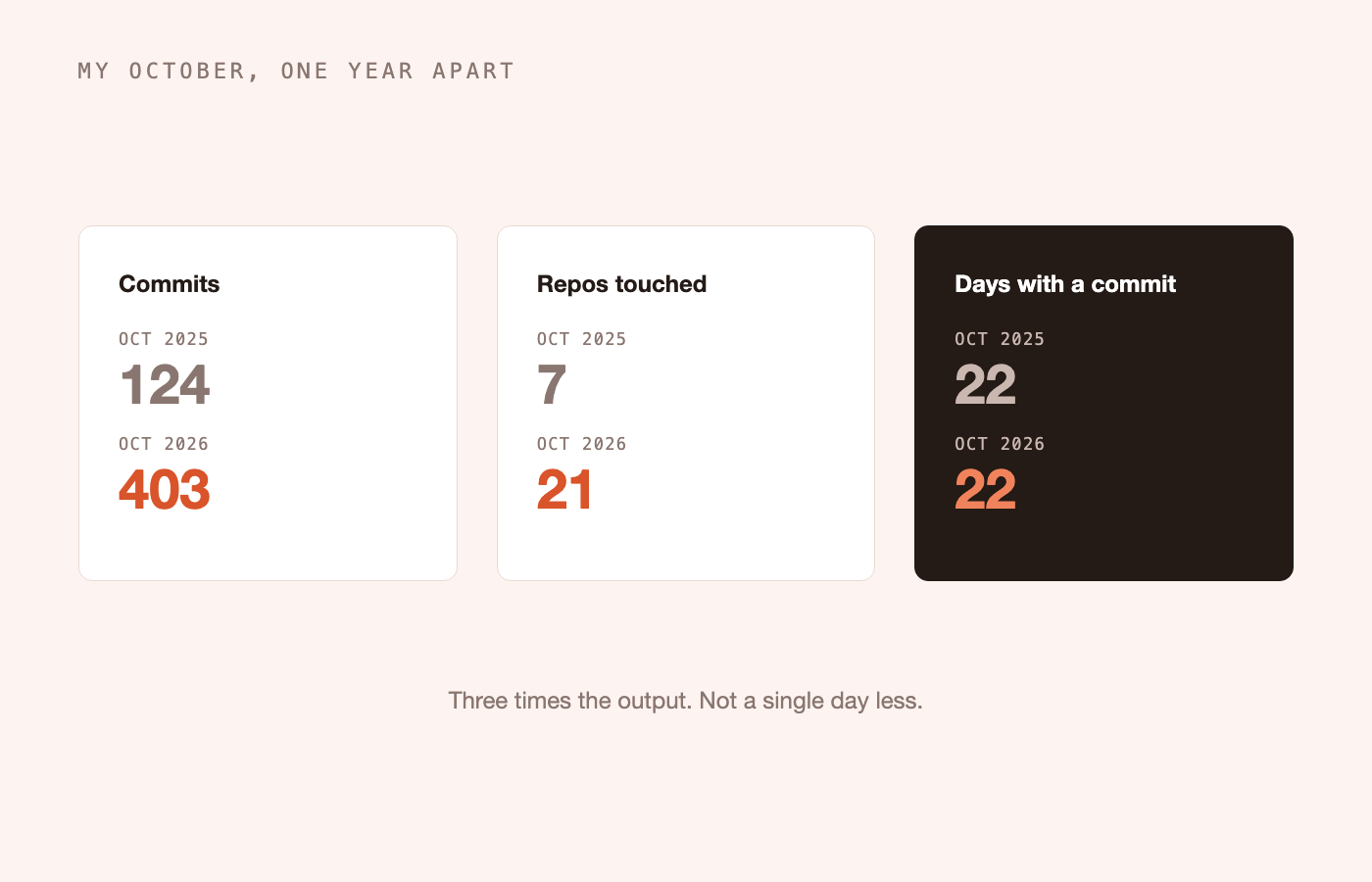
I know commits are a bad metric. Agents commit in smaller pieces then I used to, so some of that jump is just noise. But even if you cut it in half, the shape is the same. I produce much more, and I don't work any less. One in five of those commits is on a weekend. Almost 70 of them are after 10 pm.
So I want to ask the question that I think alot of people in tech are quietly asking themselves right now:
Weren't we supposed to work less?
The promise
In 1930, John Maynard Keynes wrote a short essay called Economic Possibilities for our Grandchildren. He predicted that in about a hundred years, productivity would grow so much that people would only need to work around fifteen hours a week. Three-hour shifts. The real problem of humanity, he thought, would be figuring out what to do with all the free time.

John Maynard Keynes in 1929, a year before he wrote the essay. Public domain.
A hundred years from 1930 is 2030. We have four years left.
The funny thing is, he was right about half of it. Productivity really did grow as much as he expected, even more in some countries. What did not arrive is the free time. The 40 hour week is still the norm, and in Türkiye the average is closer to 45. If you ask me, we are not going to hit 15 hours by 2030.
And now we have AI, which is supposed to be the biggest productivity jump since electricity. If there was ever a moment for Keynes to be right, it is this one. So why does it feel like the opposite?
The research says the same thing
I thought maybe it was just me. A student who can not stop opening new projects. But it turns out researchers are seeing the same pattern everywhere.
In February 2026, two researchers from UC Berkeley published a study in Harvard Business Review. They followed around 200 people at a US tech company for eight months. The company gave everyone AI tools but did not force anybody to use them. What happened? People worked faster, took on more tasks, and stretched their work into more hours of the day. Nobody asked them to. They just did.
The loop they describe is very simple, and I recognized myself in it immediately:
- AI makes a task faster.
- Because it is faster, everyone expects it faster.
- Because it is expected faster, you lean on AI even more.
- Because you lean on it more, you take on more work.
And then it starts again from step one.
There is also an NBER paper that looked at American time use data from 2004 to 2023. People in jobs that are more exposed to AI work roughly three hours more per week, and they lose about the same amount of free time. Not the time scrolling on the phone, mostly the time with friends, relaxing, traveling. The real stuff.
This has a name
Economists have a name for this, and it is from 1865. William Stanley Jevons noticed that when steam engines became more efficient with coal, England did not use less coal. It used much more. Because cheaper energy meant more things became worth doing with it.
That's the Jevons paradox, and I think it is the best explanation for what is happening to us. When writing code gets cheaper, we don't write the same amount of code in less time. We write more code. When an app takes a weekend instead of a month, you don't take the rest of the month off. You build three more apps. Ask me how I know.
The saved time does not disappear. It just goes somewhere. And it is worth asking where.
Feeling fast is not the same as being fast
Here is the part that makes it worse. Sometimes we are not even faster, we just feel faster.
In 2025, a research group called METR did an experiment with experienced open source developers working on their own repositories. With AI tools, they were 19% slower. But when they were asked after, they believed AI had made them about 20% faster. They were wrong by almost 40 points, about their own work. METR ran a follow-up in 2026 and this time the result went slightly the other direction, but it was so noisy that even they don't trust it much.
I am not saying AI makes you slower. For me it clearly doesn't, I would never have built half of my projects without it. But that feeling of speed is very convincing, and it pushes you to say yes to one more thing. And another one.
Then there is the stuff that looks finished but isn't. Researchers at Stanford call it "workslop": AI generated reports, emails and code that look polished but don't actually move anything forward. In their survey, 40% of desk workers said they received something like this in the last month, and each one cost them around two hours to deal with. So one person saves an hour by generating something, and someone else loses two fixing it. On the spreadsheet it looks like productivity. In reality it is just moving the work to somebody elses desk.
The day doesn't end anymore

An office building in Vienna at night. Photo by Thomas Quine, CC BY 2.0.

Microsoft calls it the "infinite workday". From their own data, about 40% of people are already checking email by 6 am, and meetings after 8 pm went up 16% in one year. To be fair, Microsoft sells the AI tools that are supposed to fix this, so take it with some salt. But I don't think anyone reading this needs a report to believe it.
And in some parts of the industry, they are not even hiding it anymore. Some AI startups in San Francisco openly ask for "996": 9 am to 9 pm, six days a week. This is the work model that people in China protested against with a GitHub repo back in 2019, and now it is being imported to Silicon Valley as a badge of honor. One founder basically said that if you want a 40-hour week, you are probably not a good fit.
Think about this for a second. The companies building the tools that are supposed to free our time are the ones asking for the longest weeks. Thats not a small irony.
So who gets the time?
I think this is the real question, and it is not a technical one.
When AI saves an hour, that hour can go to three places:
- You, as free time.
- Your employer, as more output from the same salary.
- The customer, as cheaper or faster products.
Keynes assumed most of it would go to the first one. History says it mostly goes to the second and third. Not because of some evil plan, but because nobody stops and decides otherwise. The default is always more.
This is also why my previous two posts and this one are kind of two sides of the same coin. In those I wrote about people losing their positions. Here it is the opposite problem: the people who keep their jobs end up doing the work of the ones who left, plus more, because "you have AI now". Less people, more work per person. Same tool.
And for me as someone from Türkiye, it is even more personal. We are already one of the longest working countries in the OECD. Around 15% of people work more than 60 hours a week, when the OECD average is about 4%. If AI gains go to the default, I am pretty sure where they will go back home. Living in Estonia now, I see a different culture, where leaving at 5 is normal and nobody looks at you weird. But even here, the laptop comes home with me.
What I'm trying to do about it
I don't have a perfect answer. I am writing this at night, so obviously I have not solved it. But here is what I'm trying:
Decide where the hour goes before you save it. If AI is going to save me two hours on a task, I try to decide before I start what those two hours are for. If I don't decide, the backlog decides for me. It always does.
Have a stopping rule, not just a starting rule. The Berkeley researchers suggest something they call "AI practice": clear rules not only on how to use AI, but on when to stop. For me the rule is simple. No new project after 10 pm. I can finish things, but I don't start things. (Yes, I broke it this month. Several times.)
Don't measure yourself in output. 403 commits sounds great until you ask what they were for. Some of those 21 repos I will never open again. Shipping more is not the same as doing better, and AI makes it very easy to confuse the two.
Count the time, not just the tasks. Next month I want to look at the same numbers again. But this time I want the days with a commit to go down, while the important stuff still gets done. That would be the first real productivity gain I can actually feel.
Four years left
Keynes was not naive. He knew people would keep wanting more. But I think he imagined that at some point we would look around and say, ok, this is enough, now let's live.
We now have tools that he could not even imagine. They really do save time. I see it everyday. The question was never if the technology could give us a shorter week. The question is whether we take it, or we just let the extra hours fill themselves up with more work, like they always did.
Four years until 2030. I am not optimistic about the 15-hour week. But I would be happy with getting back even one of those 22 days.