Aug 13, 2026 · 8 min read
In Two Years, Your Position Won't Exist
I have shipped more code in the past six months than in any six months of my career, and I typed a smaller share of it than ever. If I am honest, I cannot remember the last time I wrote a whole function by hand. Neither can you, probably. And here is the part we only say quietly: none of us write better code than the AI anymore. Not faster, not cleaner, not with fewer bugs. That race is over, and we were not the ones who won it.
So when people ask whether AI will take our jobs, my answer is yes and no. But I will go further, because I think the timeline is shorter than anyone wants to hear. Two years from now, you will very likely not be working in your current position. Not because you got fired. Because the position will not exist.
Let me explain why I believe that.
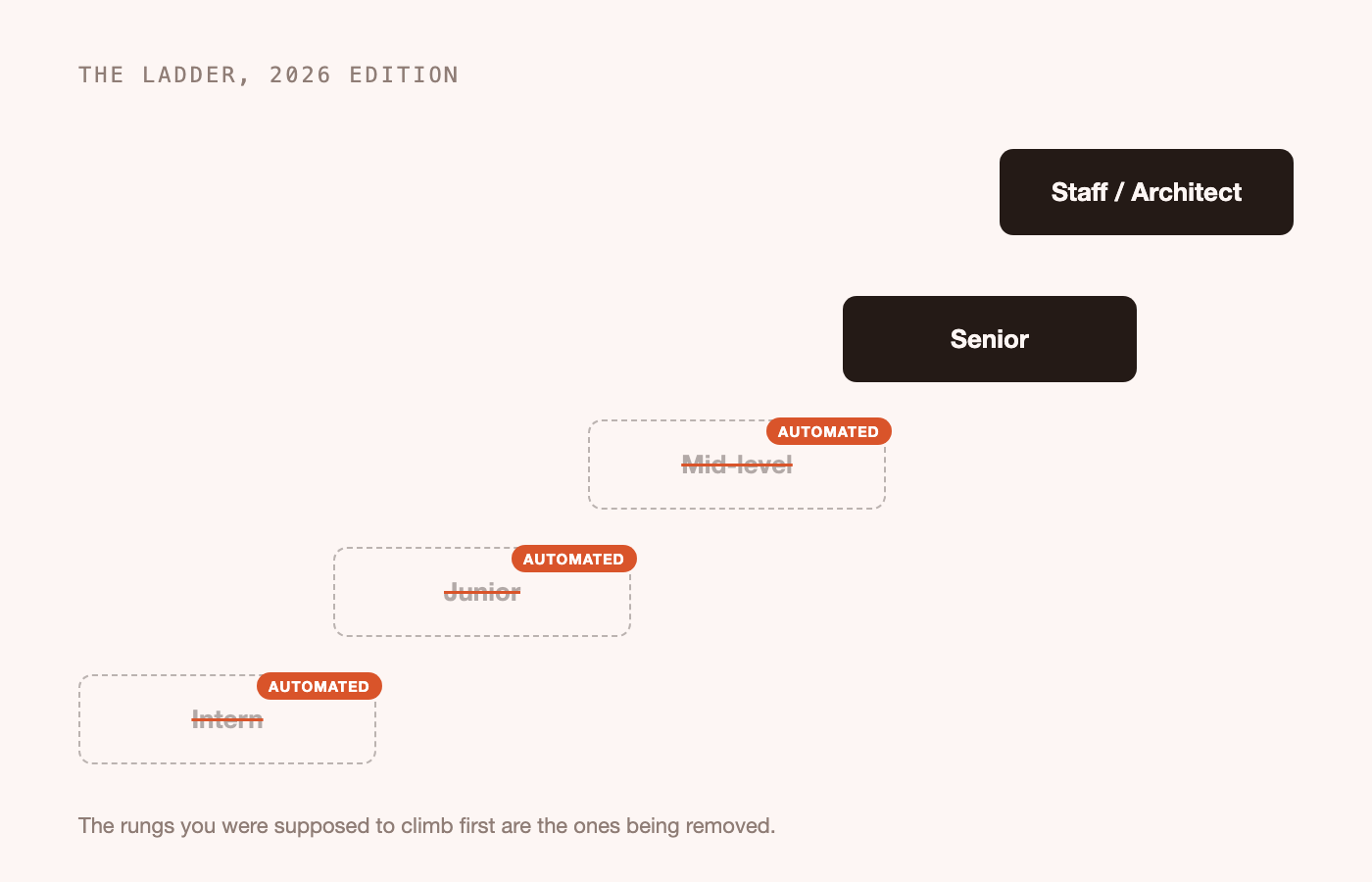
The bottom rungs are not shrinking. They are being removed.
Think about what a junior or mid-level engineer actually does most of the day. Someone hands them a well-scoped task: build this screen, add this endpoint, fix this bug, write these tests. They turn a described piece of work into working code.
That is not a caricature, that is the job. And it is precisely the job that AI tools do now, faster, cheaper and without a single one-on-one meeting. From a company's point of view the comparison is brutal: an agent does not need onboarding, does not need a laptop, and does not resign after two years.
So I will say the uncomfortable version out loud: these roles are not going to shrink. In many companies they are going to disappear. Hiring for them already looks less like a slowdown and more like a deletion. When people say "the market is bad for juniors", I think they are misreading a permanent change as a temporary one.

The desks are still there. The question is who was supposed to be sitting at them. Photo by Rashed Hossain, CC0.
The pipeline paradox
Here is where it gets genuinely unfair.
If nobody hires juniors, where do seniors come from?
Every senior engineer I respect became one the same way: years of writing code by hand, breaking things, being wrong in code review, carrying a pager. The bottom rungs of the ladder were not decoration. They were where judgment got built. We are now removing them and quietly assuming the top of the ladder will keep replenishing itself.
Tuna Tuğcu, a computer engineering professor from Türkiye, wrote a thread about this that stuck with me. His point: the real crisis does not hit today, it hits when the current generation of well-trained engineers retires. If universities keep teaching as if AI does not exist, and companies keep saying "why would we need juniors", then in ten to fifteen years we are left with people who can prompt but cannot engineer. The industry is optimizing away its own future and calling it efficiency.
The university path is broken

Photo by cogdogblog, CC0.
For decades the deal was simple: go to university, pick a direction somewhere along the way, graduate, get a junior job, and figure the rest out on company time. That deal is over. Graduating has never been easier. The first job has never been harder, because most companies simply do not need you the day you graduate. Whatever you can offer on day one, an agent already offers cheaper.
And this is the harshest thing I will write here: if your foundations are not already solid, if this field was not a genuine curiosity of yours since high school, then "I will go to university and find my way" barely works as a plan anymore. The people who will be fine are the ones who were taking things apart long before anyone paid them to do it.
If you are graduating into this market, I see three doors that still open:
- Pick a lane almost nobody picks. Not mobile. Not backend. Not frontend. Those are the widest lanes, which means the most training data, the most tooling, and the most automation pressure. Go where the crowd is not: embedded systems, compilers, GPU work, safety-critical software, the strange corners where problems are messy and data is thin. Specific now beats general.
- Go academic. Honestly, I think this is the most sensible option right now. The entire education system needs to be rebuilt for the AI era, and somebody has to do that research and that teaching. It is also one of the last places where deeply understanding things is the whole job, not an inconvenience.
- Build your own things. Ship your own SaaS, your own apps, and hold on. Nobody can delete a position you created for yourself. This is the door I know best: most of what I actually know came from shipping my own products, not from tickets.
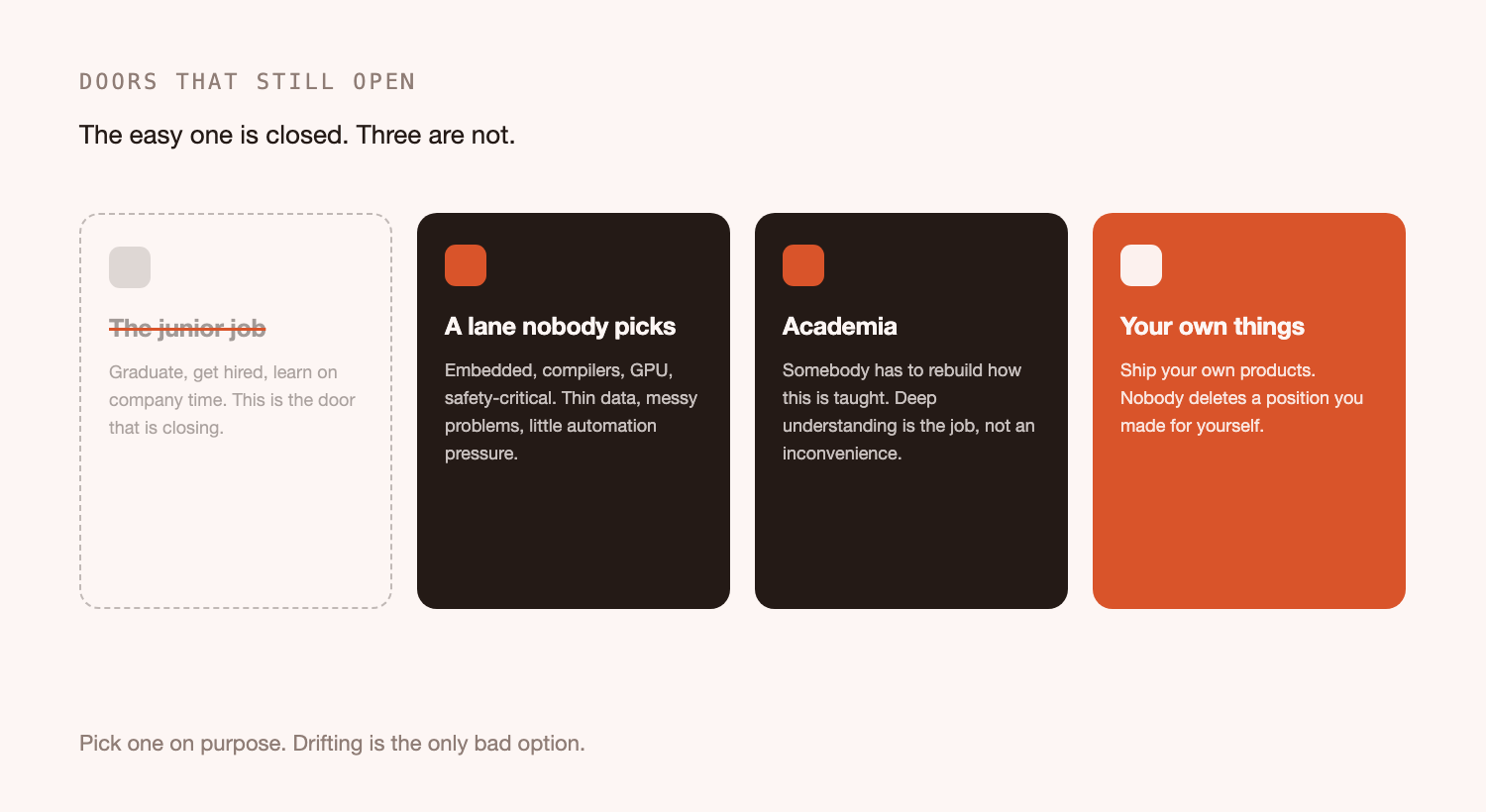
None of these doors are easy. That is exactly the point. The easy door was the junior job, and it is closing.
The Ferrari problem
The professor's thread had a metaphor I keep coming back to. An engineer with strong fundamentals using AI is flying. An engineer without them is flooring a Ferrari on a straight road, feeling like a great driver right up until the first corner.
I feel this every single day. When I build with AI, the reins slip out of my hands quietly. The agent is confident, the code compiles, the demo works.
It is very easy to believe you are steering when actually the horse is just running in a direction you happen to like.
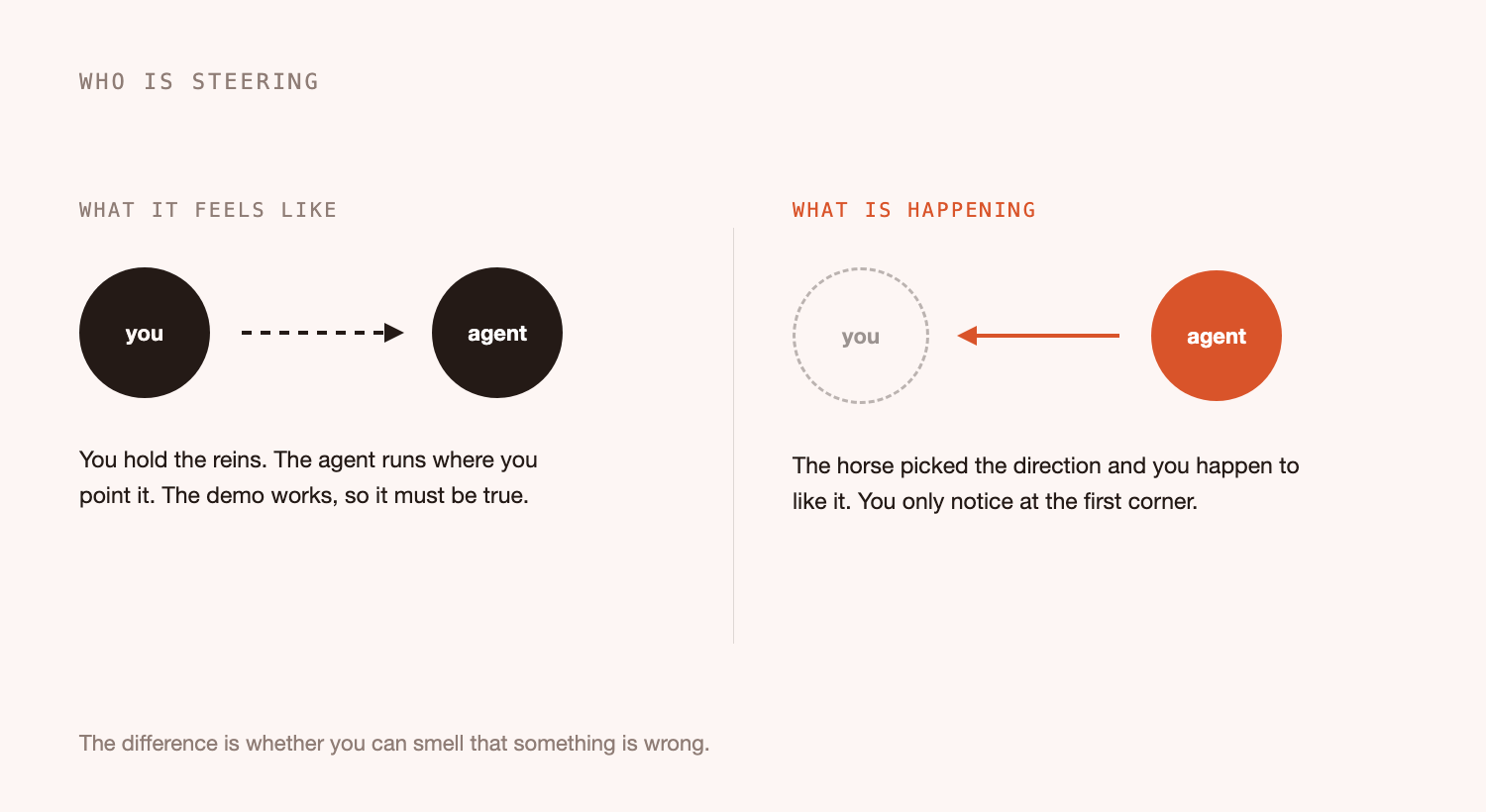
The only thing that keeps me in control is that I can smell when something is wrong: a data model that will not survive scale, a race condition hiding in an innocent-looking handler, a dependency that will hurt us in a year.
That smell is not talent. It is residue. It comes from years of writing, shipping and debugging code by hand, mostly badly. Which is the whole tragedy of the pipeline paradox: the thing that makes seniors effective with AI is exactly the experience we are no longer letting juniors have.
And to be clear about what "fundamentals" means: not syntax. Operating systems, computer architecture, databases, data structures, distributed systems. If those words feel optional to you, you will not notice when the AI is wrong, and it will not warn you.
Two ways forward
So if the middle of the ladder is going away, where do you actually go? I see two honest paths, and I will put a number on it: I think everyone in this industry has roughly two years to land on one of them.
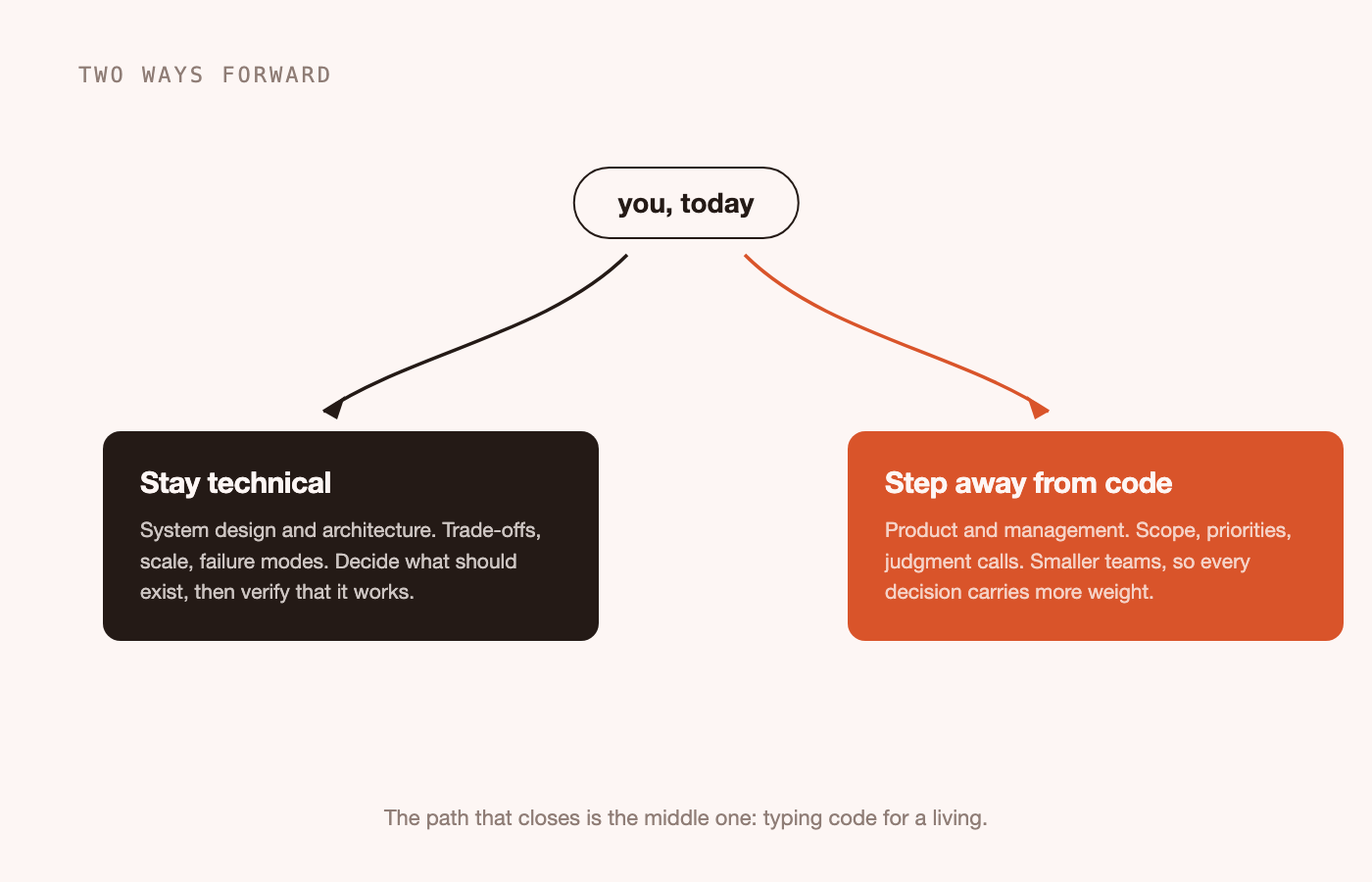
If you want to stay technical, become an architect. The value is moving from writing code to deciding what code should exist. System design, architecture, the unglamorous discipline of trade-offs: consistency versus availability, cost versus latency, boring versus clever. An agent can produce a service in an afternoon. It cannot own the consequences of that service across a hundred other services and five years of growth. Someone has to hold the whole system in their head, set the constraints, and verify the result. That someone is very well paid, and will be for a long time.
If you do not want to go deeper technically, become a PM. Product, project, engineering management. Scope, priorities, saying no, translating between what the business wants and what the system can survive. But I will not sugarcoat this path either: it shrinks too. When one person plus agents does the work of six, there are fewer people to manage. The manager of the next decade coordinates fewer humans and makes more decisions per human. The role survives, the headcount does not.
Notice what is missing between these two paths: the thing most of us were actually hired to do. Sitting down, taking a ticket, and typing out the implementation. That middle lane is the one closing. Writing code is leaving our lives the way developing film left photography: not because images stopped mattering, but because the manual step stopped being where the value was.
What I would do today
If you are a student or trying to break in: pick one of the three doors above, deliberately, and then do the unfashionable thing. Learn the fundamentals by hand, with real discipline. Do things AI could do for you, not because it is efficient but because it is how judgment forms. Then use AI on top of that knowledge and you will be terrifyingly productive. Use it instead of that knowledge and you are the Ferrari on the straight road.
If you are mid-level right now: the two-year clock is loudest for you. Pick architect or PM this year, on purpose, and start doing parts of that job before anyone gives you the title. Drifting is the only genuinely bad option, because the ground you are standing on is the exact ground being removed.
And at any level, one rule I try to never break: do not ship what you cannot review. The day you approve code you do not understand is the day the horse starts steering.
Two years
Will AI take our jobs? Still yes and no. The job called "person who converts tickets into code" is going away, and I do not think it is coming back. The job called "person who decides, designs and verifies" is getting bigger, better paid, and harder to qualify for.
That is why the title of this post is a sentence I actually believe.
Two years from now, you will most likely not be working in your current position, because your current position will not exist.
It is not a threat. It is a deadline. The only real question is which of the two remaining jobs you will be qualified for when it arrives.